Article
Digital transformation across enterprise ecosystems depends on how effectively systems exchange data. Mobile applications, cloud platforms, customer portals, and partner integrations all rely on Application Programming Interfaces (APIs) to function.
Yet many established enterprises still depend on legacy interface architectures: monolithic backend endpoints, outdated SOAP and XML protocols, unversioned REST services, and tightly coupled database connections. These aging APIs create significant development bottlenecks, suffer from unpredictable latency, and introduce critical security vulnerabilities across distributed networks.
API modernization is not simply wrapping a legacy database in a generic REST wrapper. It is a strategic engineering initiative to decouple systems, standardize data contracts, enforce Zero Trust security, and improve performance.
This guide explores modern API architecture patterns, protocol selection models, security governance, and a step-by-step blueprint for migrating legacy interfaces with zero downtime.
1. Why Legacy APIs Fail Under Modern Workloads
Legacy APIs were designed for static, on-premises environments where system traffic was predictable and consumers were mostly internal desktop applications. Today, those systems struggle under modern software requirements:
-
Payload and Protocol Inefficiencies: Heavy XML structures and chattiness in older SOAP services consume unnecessary network bandwidth and slow down mobile and web clients.
-
Tight Architectural Coupling: Legacy APIs often expose raw database schemas directly to clients. Any internal schema change instantly breaks external client applications.
-
Lack of Centralized Governance: Unmanaged "zombie" and "shadow" APIs operate without rate limiting, authentication standards, or centralized logging, creating major security attack vectors.
-
Documentation and Contract Drift: Outdated or missing documentation forces frontend and partner teams to reverse-engineer endpoints, drastically slowing feature releases.
2. Core Architectural Patterns for API Modernization
Replacing an entire API portfolio in a single release creates severe operational risk. Modern engineering teams use proven architectural patterns to modernize incrementally.
The Strangler Fig Pattern
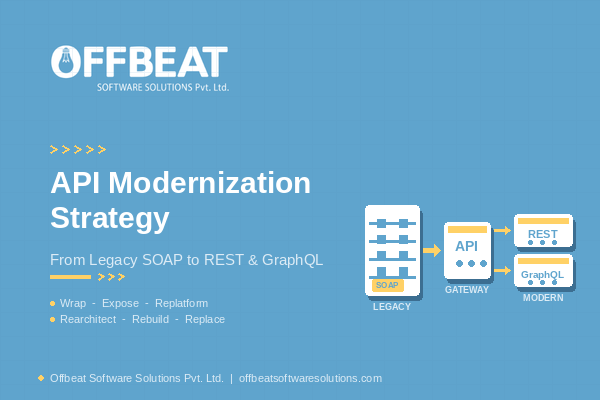
The Strangler Fig pattern gradually replaces legacy API endpoints with modern microservices or serverless functions behind an API gateway:
-
An API Gateway intercepts all incoming client traffic.
-
New features or modernized endpoints are built as independent services.
-
The gateway routes requests for updated paths to the new services while routing untouched legacy requests to the old backend.
-
Over time, all legacy endpoints are replaced until the old system can be cleanly retired.
The Facade and Adapter Pattern
When legacy core systems (such as mainframes or legacy ERPs) cannot be rebuilt immediately, an API facade layer sits in front of them. The facade translates modern JSON payloads and REST or GraphQL queries into legacy SOAP, RPC, or binary formats, providing external consumers with a clean modern interface while preserving backend stability.
The Event-Driven API Pattern
Synchronous request-response models create performance bottlenecks when handling long-running background tasks. Event-driven APIs utilize message brokers (such as Apache Kafka or RabbitMQ) and Webhooks to process tasks asynchronously, notifying consumers when jobs complete without keeping client connections open.
3. Protocol Selection: REST vs. GraphQL vs. gRPC vs. Webhooks
Modern architectures rarely rely on a single protocol. High-performing systems select protocols based on client requirements and latency constraints.
| Protocol | Best Use Case | Primary Strength | Architectural Consideration |
| REST (OpenAPI / JSON) | Public APIs, standard web and mobile clients | Universal compatibility and simple HTTP caching. | Can lead to over-fetching or under-fetching of data. |
| GraphQL | Complex frontend dashboards, dynamic mobile apps | Clients request exact data fields needed in a single round-trip. | Increases backend query complexity and caching overhead. |
| gRPC (HTTP/2 / Protobuf) | High-throughput internal microservice communication | Binary serialization, multiplexing, and ultra-low latency. | Requires contract sharing via Protocol Buffers; limited direct browser support. |
| Event-Driven / Webhooks | Real-time notifications, asynchronous data processing | Decouples publishers from subscribers with immediate delivery. | Requires event ordering guarantees and retry logic handling. |
4. Security, Identity, and Governance in Modern APIs
Securing modernized APIs requires shifting away from basic API keys and static IP whitelisting toward identity-centric security:
-
OAuth 2.0 and OpenID Connect (OIDC): Implement token-based authentication using short-lived JSON Web Tokens (JWTs) validated at the gateway layer.
-
Granular Rate Limiting and Throttling: Protect downstream infrastructure by enforcing token bucket or sliding-window rate limits per client, API key, or IP address.
-
Zero Trust Policy Enforcement: Validate and sanitize every request at both the API gateway and individual service boundaries to prevent Broken Object Level Authorization (BOLA) vulnerabilities.
-
Automated Contract Testing: Use tools like Spectral, OpenAPI linters, and Pact to enforce schema consistency and prevent breaking changes from reaching production pipelines.
5. The 5-Stage API Modernization Roadmap
Executing an API modernization project follows a structured engineering sequence to maintain system availability:
Stage 1: API Portfolio Discovery and Dependency Mapping
Audit all existing APIs across your organization. Document traffic volumes, consumer dependencies, authentication methods, data models, and error rates to identify high-risk bottlenecks.
Stage 2: Deploying an Enterprise API Gateway
Deploy a centralized API gateway (such as Kong, Apigee, Azure API Management, or AWS API Gateway). The gateway establishes a unified point of entry for traffic routing, centralized telemetry, SSL termination, and token authentication.
Stage 3: Designing Contract-First Interfaces
Adopt an API-First design methodology. Define standard OpenAPI (Swagger) or Protobuf specifications before writing backend implementation code. This allows frontend and backend teams to develop in parallel using automated mock servers.
Stage 4: Service Decoupling and Facade Implementation
Build modern microservices or facade adapters to handle specific business domains. Implement asynchronous messaging for long-running workflows and configure caching layers (such as Redis) to offload read-heavy database traffic.
Stage 5: Traffic Routing, Validation, and Deprecation
Route a small percentage of live traffic to modernized endpoints using canary deployments. Monitor latency, error budgets, and data accuracy. Once stability is verified, route all traffic to the new services and decommission legacy code paths.
Traditional APIs vs. Modernized API Platforms
The table below highlights how modernization changes daily development and operational efficiency:
| Capability | Legacy API Environment | Modernized API Architecture |
| Data Format | Heavy XML, unstructured JSON, or proprietary binary. | Strict OpenAPI JSON, Protobuf, or GraphQL schemas. |
| Scalability | Vertical scaling tied to monolithic database capacity. | Horizontal, independent auto-scaling per service. |
| Integration Speed | Weeks of manual coordination and custom code mapping. | Self-service developer portals with interactive sandboxes. |
| Observability | Fragmented server logs and delayed error discovery. | Distributed tracing, live latency metrics, and automated alerts. |
| Deployment Cadence | High-risk, scheduled releases requiring maintenance windows. | Zero-downtime CI/CD deployments and canary releases. |
Accelerate Your API Modernization with Offbeat
Modernizing mission-critical integration architectures requires deep expertise in distributed systems, secure cloud design, and interface engineering.
At Offbeat Software Solutions Pvt. Ltd., we help enterprises design, engineer, and scale modern API architectures, microservices platforms, and cloud-native systems. Whether you need to decouple legacy monoliths, deploy high-performance API gateways, build secure gRPC microservices, or implement real-time event-driven pipelines, our technical teams deliver resilient software solutions built for performance and scale.
Ready to modernize your API architecture and eliminate legacy bottlenecks? Connect with the software engineering team at Offbeat Software Solutions Pvt. Ltd. today to map out your technical strategy.
Frequently Asked Questions
What is the primary difference between an API wrapper and true API modernization?
An API wrapper simply translates requests to an existing legacy system without altering underlying performance, coupling, or scalability. True API modernization redesigns data models, decouples backend dependencies, optimizes protocols, and establishes modern governance and observability.
How does an API gateway improve system security?
An API gateway acts as a reverse proxy that centralizes authentication (OAuth2/JWT validation), enforces rate limits to prevent DDoS attacks, sanitizes incoming payloads, and blocks unauthorized traffic before requests reach internal microservices.
When should a company choose gRPC over REST?
gRPC is ideal for internal microservice-to-microservice communication where ultra-low latency, bidirectional streaming, and high throughput are essential. REST remains the standard choice for public-facing APIs, web applications, and third-party integrations requiring broad browser compatibility.
How do you prevent breaking changes during API migration?
By enforcing strict API versioning (either through URI path versioning like
/v1/ or header versioning), maintaining backward-compatible schema evolutions, and utilizing automated contract testing tools within your CI/CD pipeline.