
Article
Not every slow, manual process needs AI thrown at it. Some just need to be redesigned. Knowing the difference before you invest in either is the actual skill here - not defaulting to whichever one sounds more modern.
When the problem is actually the process, not the lack of AI
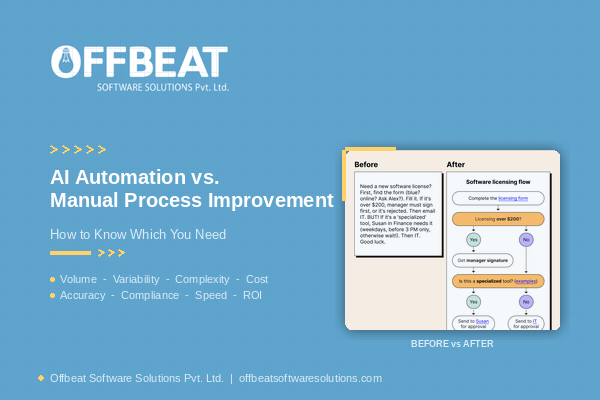
If a workflow is slow because of unnecessary handoffs, unclear ownership, redundant approval steps, or data scattered across systems that don't talk to each other, adding AI on top of that mess doesn't fix it - it just automates the mess faster. In cases like this, the honest first move is process redesign: cutting steps, clarifying ownership, and connecting the systems that should already be talking to each other. That's often cheaper, faster to implement, and lower-risk than an AI initiative, and it frequently solves the actual complaint.
When AI is genuinely the right tool
AI earns its place when the bottleneck is specifically about judgment at volume - analyzing unstructured information, extracting meaning from documents, or making a first-pass risk assessment faster than a human reasonably can at scale, while still leaving a human in the loop for the decision that matters. That's the shape of problem behind LendiFlow, a lending platform we built for real estate private lenders. Private lending was being slowed down by manual underwriting and document verification that could take days or weeks per loan. We integrated AI-powered risk analysis into the platform to analyze borrower financials and property data and produce instant feasibility summaries and risk scores, alongside automated document categorization and verification - work that's fundamentally about processing volume and unstructured information faster, which is exactly where AI adds real value instead of just adding complexity.
The test that actually separates the two
Ask: is the current process slow because a human has to manually do something a computer could already do reliably with simple rules (routing, data entry, status updates) - or is it slow because a human has to read, judge, and synthesize unstructured information at a volume no team can keep up with? The first is a process/automation problem, solvable with workflow redesign and standard automation, no AI required. The second is where AI-assisted analysis, like the risk scoring built into LendiFlow, genuinely changes the economics of the work.
A caution worth stating plainly
AI in a business workflow works best as assistance with defined checkpoints, not a fully autonomous decision-maker - LendiFlow's AI risk scoring accelerates the underwriting pipeline, it doesn't replace the lender's final judgment call. Any pitch that promises AI will run a business-critical process end-to-end with no human review is overselling what's actually reliable today.
How to actually decide for your situation
Map the process step by step before deciding anything. If most of the delay is handoffs and disconnected systems, fix that first - it's usually the cheaper, faster win, and it may be all you need. If the delay is genuinely about judgment at a volume no human team can sustain, that's the real signal AI automation is worth evaluating, not just as a project, but as an assessment of where it fits into your specific workflow.
Get a Free Assessment