Article
"Just use an off-the-shelf tool" is good advice most of the time - until it isn't. Here's a genuinely balanced way to think about when a generic SaaS product is the right call, and when it starts actively working against you.
The honest case for off-the-shelf
Generic SaaS tools exist for a reason: they're cheaper to start with, they're maintained by someone else, and they cover common workflows well because thousands of other companies have already shaped the product through their own feedback. If your workflow looks like most other companies' workflow in your category, an off-the-shelf tool is very likely the right answer, and building custom software to solve a problem a $50/month tool already solves is a bad use of engineering budget.
Where off-the-shelf starts to break down
The pattern we see most often is a company outgrowing a generic tool's data model, not its feature list. Off-the-shelf software is built around a general-purpose schema that has to work for every customer - which means it's rarely built around the specific, high-volume, specialized data your business actually runs on.
That was the core problem behind Karneyium, a platform we built for identifying optimal clinical trial site locations in the pharmaceutical industry. Site selection for a clinical trial depends on combining patient demographics, healthcare infrastructure proximity, and historical recruitment data - a genuinely specialized data problem that doesn't map cleanly onto any general-purpose SaaS category. No off-the-shelf tool was built to combine geospatial intelligence, real-world health data, and AI-driven querying in the specific way this workflow required, because that combination is specific to this industry's actual decision-making process, not a generic business need.
The real cost of forcing a generic tool to fit
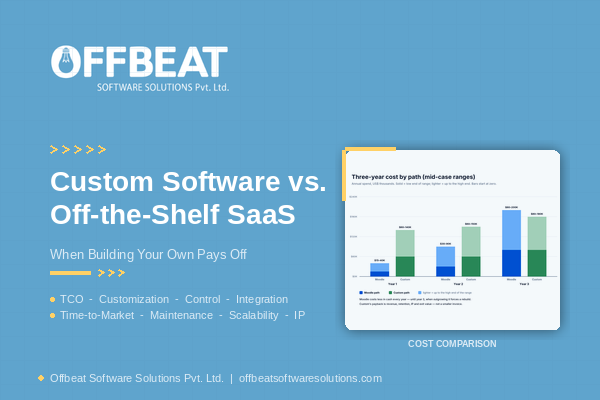
When a company tries to bend an off-the-shelf tool to a genuinely specialized workflow, the cost doesn't disappear - it shows up later, as workaround spreadsheets, manual data reconciliation between systems, and process steps that exist purely to compensate for what the tool can't do natively. That's often more expensive over time than building the right tool in the first place, it's just a cost that's spread out and harder to see on a single invoice.
The actual decision framework
Ask honestly: is the core value of what you're trying to do something a generic tool already does well, or is your competitive advantage tied up in data or a workflow that's genuinely specific to your business? If it's the former, buy. If your business depends on doing something with data or process that a general-purpose tool wasn't built to handle - the way Karneyium needed to combine geospatial, demographic, and generative-AI querying in one purpose-built system - custom software isn't over-engineering. It's matching the tool to the actual shape of the problem.
What this doesn't mean
It doesn't mean build everything custom. Most of a company's software stack should stay off-the-shelf - email, calendaring, generic CRM, accounting. The question is narrow: is there one specific workflow where a generic tool is quietly costing you more than it's saving, through workarounds and manual effort that never show up as a clean number?
If you're not sure which side of that line your situation falls on, that's worth an honest conversation before committing budget either way.
Discuss Your Product