

Legacy Dashboard Modernization | 5-Minute Loads Cut to Under 5 Seconds
Client / Industry
Logistics
Existing Technology Stack
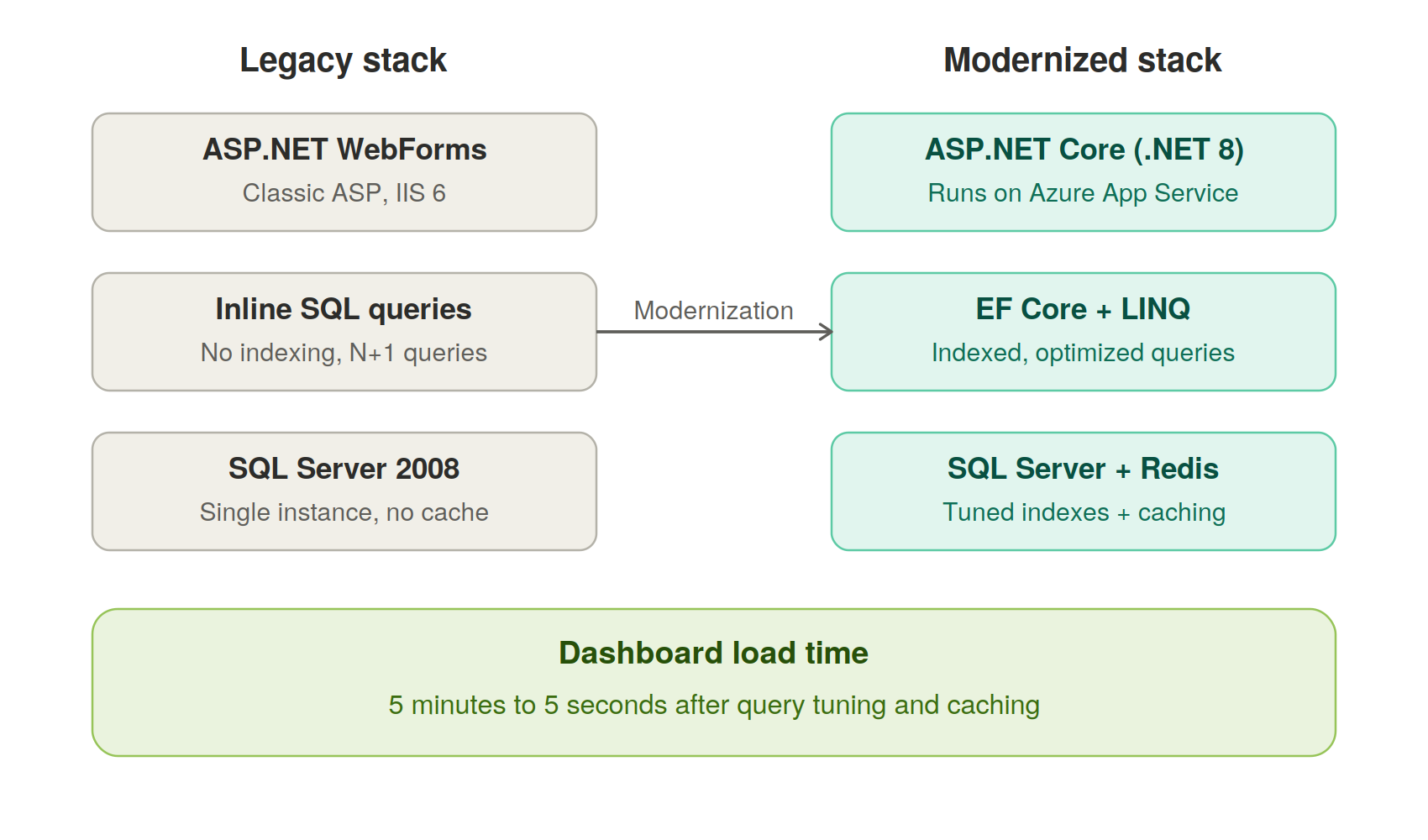
ASP.NET WebForms on IIS 6, inline SQL, single uncached SQL Server 2008 instance
🛑 The Business Challenge
The application ran on ASP.NET WebForms on IIS 6, with inline SQL queries scattered throughout the codebase, no indexing strategy, and a single SQL Server instance handling every read and write with no caching layer. Every new data source the business added made the problem worse, and a full rewrite carried too much risk for a system this business-critical.
- Unusable performance: reports were taking up to 5 minutes to load, blocking time-sensitive operational decisions
- Inline SQL scattered throughout the codebase with no indexing strategy
- N+1 query issues silently multiplying database load on every page render
- A single uncached SQL Server instance handling every read and write
- Too much risk for a full rewrite on a system this business-critical
Modernization Strategy
Incremental modernization of the application layer, data layer, and infrastructure — no full rewrite
Solution: Incremental Modernization, Zero Downtime
Rather than a ground-up rewrite, we modernized the stack incrementally so the client's team could keep operating throughout the migration.
- Application Layer: Moved to ASP.NET Core on .NET 8, replacing scattered inline SQL with Entity Framework Core and a proper repository pattern
- Query & Index Audit: Audited every slow query, rebuilt the SQL Server indexing strategy around actual usage patterns, and eliminated a series of N+1 query issues
- Caching Layer: Added Redis in front of the most frequently hit reads, so repeat requests no longer touched the database at all
- Cloud Migration: Moved to Azure App Service, giving automatic scaling headroom and removing the maintenance burden of the old on-premises IIS server
Migration & Testing Approach
Layer-by-layer migration (app layer, then query/index audit, then caching, then infrastructure) while the client kept operating
Production Transition
Zero-downtime cutover to Azure App Service
💻 Modern Technical Architecture
Backend: ASP.NET Core (.NET 8) with Entity Framework Core and a repository pattern replacing scattered inline SQL
Data: SQL Server with an indexing strategy rebuilt around real usage patterns, fronted by Redis caching
Infrastructure: Azure App Service, replacing the on-premises IIS 6 server entirely
Migration Approach: Incremental modernization with zero downtime — no big-bang cutover
Technology
📋 Project Technical Summary
| SEO Category | Technology Implemented |
|---|---|
| Industry | Logistics |
| Original Stack | ASP.NET WebForms, Classic ASP, IIS 6, SQL Server (no caching) |
| Modernized Stack | .NET 8, ASP.NET Core, EF Core, Redis, Azure App Service |
| Migration Approach | Incremental modernization, zero downtime |
| Key Outcome | Load time cut from ~5 minutes to under 5 seconds |
Result
Dashboard load time dropped from roughly 5 minutes to under 5 seconds, with zero downtime during migration
Business Impact
The client's own team can now maintain the system, rather than depending on a black box only the original developer understood
🚀 Project Results & Impact
⚡
60x Faster: Load time dropped from ~5 minutes to under 5 seconds
✅
Zero Downtime: The migration ran with no disruption to daily operations
🤝
Maintainable Handoff: The client's own team can now maintain the system going forward
Discuss a Similar Project
Have a similar project in mind? Let's discuss your specific requirements.