Article
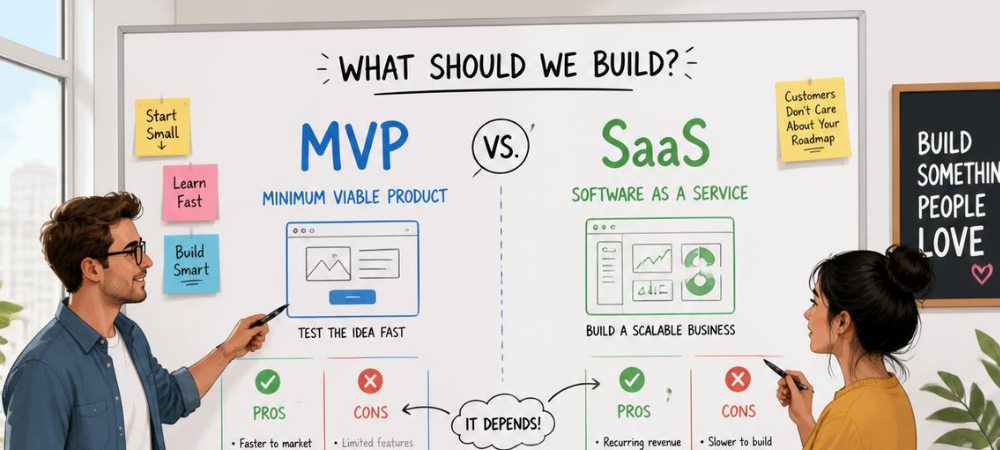
Every startup begins with a distinct vision. However, the way you choose to bring that vision to life dictates whether your product thrives or stalls in a competitive market. One of the most critical crossroad decisions an early-stage founder must make is whether to invest immediately in full scale SaaS development or launch a lean Minimum Viable Product (MVP) first.
It is a high-stakes choice. If you build too much too soon, you risk exhausting your runway on features that your target audience does not actually need. Research shows that 35% of startups fail simply because there is no genuine market demand for their completed platform. Conversely, if you start too small without a modular architectural blueprint, scaling your system later can become incredibly difficult.
The secret to success lies in matching your execution strategy to your product's current lifecycle stage.
Defining the SaaS MVP
In modern software engineering, a SaaS MVP is the absolute leanest version of your application that can be deployed to solve a single, primary user problem. It highlights your core value proposition while intentionally leaving out any secondary tools or non-essential features.
The fundamental objective of an MVP is market validation rather than technical perfection. Instead of spending a year writing complex code inside a closed dark room, an MVP gets your software into the hands of real users within weeks. This allows you to collect behavioral metrics, track usage patterns, and uncover real pain points early.
-
A Practical Example: If you are building a new project management platform, your initial MVP should focus purely on basic task creation and tracking. Advanced capabilities, such as custom app integrations, deep data dashboards, or automated reporting tools, can wait until your core workflow engine proves its value.
For fast-moving tech startups, this agile framework minimizes financial risk and guarantees that future feature investments are backed by hard user data instead of guesswork.
Defining Full Scale SaaS Development
A full scale SaaS product is a completely realized, production-ready application engineered for long-term growth and high-volume market competition. It moves far beyond an isolated feature set to offer an exquisite user experience, deep third-party integrations, and a rock-solid infrastructure.
Unlike an early-stage MVP, a full scale platform is built from the ground up to support high user concurrency, complex multi-tenant workflows, and advanced commercial monetization models.
A complete enterprise platform generally requires:
-
Elastic Cloud Infrastructures: Automated resource scaling, using setups like AWS or Microsoft Azure, to handle unexpected traffic spikes smoothly.
-
Rigorous Security & Compliance: Comprehensive user data privacy protections, regional compliance configurations (such as HIPAA or GDPR), and multi-layered data encryption protocols.
-
Premium UI/UX Design: Highly optimized user pathways, personalized dashboard settings, and seamless account management systems.
This complete engineering path requires a significant capital investment, an extended development timeline, and highly structured system planning. It is the logical next step after a product concept has successfully passed its validation tests.
SaaS MVP vs. Full Scale Development: The Core Metrics
Choosing the wrong approach at the wrong time is one of the fastest ways for a startup to deplete its capital. The two methodologies address completely different business objectives. An MVP is designed for rapid learning, while full scale development is architected for sustainable scaling.
Core Metrics: The SaaS MVP Approach
-
Primary Goal: Validate core value hypotheses and test early user engagement.
-
Time to Market: Fast-tracked deployment loops that typically take 1 to 3 months.
-
Architectural Agility: High structural flexibility, making it easy to pivot code logic based on incoming feedback.
-
Upfront Investment: Minimal cloud infrastructure paired with basic payment gateway integration.
Core Metrics: Full Scale SaaS Development
-
Primary Goal: Maximize long-term market share, outpace industry competitors, and handle mass user retention.
-
Time to Market: Multi-phase strategic development roadmap that typically spans 6 to 12+ months.
-
Architectural Agility: Structured version controls that rely heavily on modular, predictable deployments.
-
Upfront Investment: Elastic auto-scaling server networks, advanced custom APIs, and deep multi-layered security protocols.
The Decision Framework: Assessing Your Startup's Stage
To determine the ideal development track for your application, look closely at your current business indicators.
When to Prioritize MVP Development
Building an MVP is the smartest path forward if you are entering an unproven market or introducing a novel software solution. Choose the MVP route if:
-
You lack definitive, data-backed proof of a product-market fit.
-
Speed to market is essential to capture early user feedback or secure a first-mover advantage.
-
You need a functional, working software prototype to present to angel investors for a seed funding round.
-
You are operating under tight, early-stage budget constraints.
When to Commit to Full Scale Development
Jumping directly into full platform construction is a calculated risk that makes sense only when you possess absolute operational clarity. Move directly to a full SaaS build if:
-
Your core product assumptions have already been thoroughly validated through a successful proof-of-concept or extensive target market pre-orders.
-
Enterprise-level or institutional funding has been completely secured.
-
Your target market is mature, meaning users expect a highly polished, feature-complete application from the very first login.
3 Fatal Execution Mistakes to Avoid
Even with exceptional funding, software products frequently fail by repeating predictable engineering blunders:
1. Over-Engineering the Launch: Attempting to build a massive platform with dozens of secondary features before validating the primary engine. This approach delays your launch date, drains your capital, and confuses early users.
2. Accumulating Toxic Technical Debt: While an MVP prioritizes speed, writing messy, unorganized code with zero architectural layout is dangerous. When it comes time to scale, you might be forced to execute an expensive, total system rewrite from scratch.
3. Ignoring Analytics Pipelines: Launching an MVP without setting up automated behavioral tracking or clear feedback loops. If you do not measure how early adopters interact with the system, you cannot make informed development choices.
The Phased Roadmap to Scalable Software Success
For the vast majority of software startups, the most successful strategy is not choosing one option over the other. Instead, view them as sequential stages in a continuous product lifecycle.
1.Launch the Core Value MVP:Validation.
Isolate the single most critical problem your users face. Build a clean, streamlined application containing only the tools required to solve that specific issue, and deploy it to market quickly.
2.Gather Real-World Behavioral Data:Analysis.
Track exactly how early adopters navigate your platform. Identify which tools they use daily, which features they ignore, and where the user flow experiences friction.
3.Iterate and Pivot Code Logic:Refinement.
Refine the system based on concrete user insights. Polish your core functionality, eliminate redundant elements, and stabilize software behavior before investing in expansion.
4.Expand into a Full Custom SaaS Platform:Scale Architecture.
Once product-market fit is proven, confidently transition into building full-scale cloud architectures, multi-tenant databases, comprehensive security controls, and enterprise integrations.
Build Your Product Strategy with Offbeat
Navigating the transition from an early app concept to a highly secure, multi-tenant SaaS platform requires a skilled, highly adaptable development partner.
At Offbeat Software Solutions Pvt. Ltd., we help startups and enterprises transform tech visions into scalable, high-performance platforms. Whether you need to build an agile, validation-ready MVP to hit the market quickly, or you are ready to engineer a robust, elastic custom SaaS platform built for millions of concurrent connections, our technical teams ensure your code remains safe, fast, and structured for long-term growth.
Ready to architect a high-yield software strategy? Reach out to the team at Offbeat Software Solutions Pvt. Ltd. today to schedule a practical scoping workshop for your application.