Article
Beyond Lift-and-Shift: A Modern Blueprint for Migrating Legacy .NET to Cloud-Native Architecture
For years, the standard approach to legacy software migration was straightforward: Lift-and-Shift. Teams took an on-premise virtual machine (VM) running an older IIS server, cloned it into a cloud-hosted VM, and called it a day.
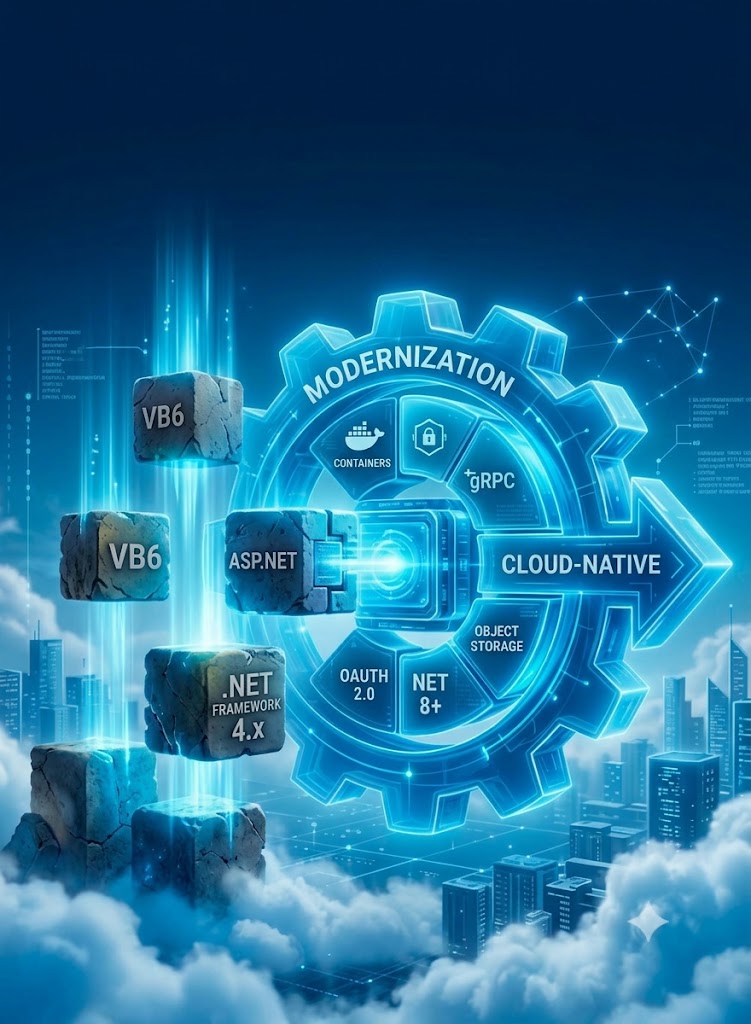
However, shifting a legacy application without modernizing it simply relocates your technical debt to someone else's hardware. With critical compliance shifts, escalating infrastructure overhead, and ending support windows—such as .NET 8 support concluding in late 2026—sticking with aging .NET Framework 4.x, ASP.NET Web Forms, or Windows Communication Foundation (WCF) architectures is a significant operational liability.
To unlock true cloud agility, cost optimization, and elastic scaling, organizations must transition from legacy hosting to a cloud-native architecture. This comprehensive blueprint outlines the technical strategies, patterns, and tools required to successfully execute this modernization journey.
1. Architectural Patterns for Migration
The ultimate goal of a modern migration isn't just running in the cloud; it's shedding OS licensing costs, removing tight system coupling, and gaining independent service scalability.
The Strangler Fig Pattern
Attempting a "big bang" rewrite of a massive enterprise monolith introduces severe risk. Instead, leverage the Strangler Fig Pattern. This approach involves gradually replacing specific business capabilities of the legacy system with modern microservices. Over time, the new services "strangle" the old monolith until the legacy application can be safely decommissioned.
Domain-Driven Design (DDD) for Deconstruction
Before writing code, identify the logical boundaries within your monolithic application. Use DDD principles to isolate Bounded Contexts (e.g., separating user authentication, billing, and inventory management). These boundaries define the scope of your future microservices, ensuring they remain highly cohesive and loosely coupled.
Implementing API Gateways
To maintain a seamless experience for end-users during a gradual migration, introduce an API Gateway (such as Azure API Management, AWS API Gateway, or Ocelot). The gateway acts as a reverse proxy, routing traffic to the legacy application by default, and seamlessly redirecting specific API endpoints to new cloud-native microservices as they are deployed.
2. Overcoming Technical Hurdles (.NET Framework vs. Modern .NET)
Migrating from .NET Framework 4.x to cross-platform .NET (8+) introduces several breaking changes that engineering teams must systematically address.
Configuration Architecture: Legacy apps rely heavily on XML-based
web.configorapp.configfiles. Modern .NET utilizes a flexible, hierarchical JSON configuration provider (appsettings.json) paired with cloud-native environment variables and secret managers (like Azure Key Vault or AWS Secrets Manager).Replacing Legacy WCF: WCF is not natively supported in modern cross-platform .NET. To modernize your service-to-service communication, transition to gRPC for high-performance RPC contracts, or refactor to standard HTTP/REST Web APIs. For scenarios where WCF codebases must be preserved in the short term, utilize community-driven alternatives like CoreWCF.
Pipeline Lifecycle: Modern .NET eliminates
Global.asaxand customHttpModules. It replaces them with a streamlined, high-performance Middleware pipeline configured explicitly inProgram.cs, which grants granular control over request handling.
3. Database Modernization Strategies
A cloud-native application is only as agile as its data layer. Migrating your application compute while leaving a massive, tightly coupled on-premise Microsoft SQL Server untouched creates a massive performance and scaling bottleneck.
Database-per-Service Pattern
To prevent microservices from becoming tightly coupled at the database level, aim to refactor monolithic databases. Each microservice should ideally own its private datastore, exposing data only through well-defined APIs.
Managed and Cloud-Native Databases
Shift from self-managed, license-heavy SQL Server VMs to fully managed relational options such as Azure SQL Database, AWS RDS for SQL Server, or cloud-native open-source engines like Amazon Aurora PostgreSQL. These services automatically handle patching, high availability, and backups.
Polyglot Persistence
Evaluate your data workloads to see where relational models fall short. Offload high-velocity or unstructured data to cloud-native NoSQL databases (such as Azure Cosmos DB or Amazon DynamoDB) to achieve sub-millisecond response times and global distribution.
4. Accelerating Migration with AI and Automation
Manually rewriting thousands of lines of legacy code used to take months or years. Today, platform-native evaluation tools and agentic AI engines can compress migrations into highly structured, manageable sprints.
Agentic AI Code Translation: Specialized migration engines, such as AWS Blu Age or automated AI refactoring agents, analyze dependency mappings and perform the heavy lifting of code conversion from legacy frameworks to cross-platform, Linux-ready modern .NET.
Targeted Upgrades: Microsoft’s .NET Upgrade Assistant provides step-by-step guidance directly within your IDE, automating boilerplate changes when upgrading project files, code dependencies, and namespaces to modern .NET versions.
Rapid Containerization: If a full code rewrite is not immediately feasible due to tight timelines, utilities like AWS App2Container (A2C) can automatically analyze IIS-hosted applications, identify network dependencies, and package them straight into Docker containers for Amazon ECS or EKS without modifying core business logic.
5. Deployment, CI/CD, and Risk Mitigation
Transitioning to cloud-native means modernizing how your code is deployed and operated.
Infrastructure as Code (IaC)
Eliminate manual environment provisioning. Define your target cloud architecture (VPCs, container clusters, databases) entirely in code using Terraform, AWS CloudFormation/CDK, or Azure Bicep. This guarantees that development, staging, and production environments remain perfectly identical.
High-Velocity CI/CD Pipelines
Cross-platform .NET allows you to run lightweight unit and integration tests inside fast, inexpensive Linux-based runners (via GitHub Actions, GitLab CI, or Azure Pipelines). This accelerates development loops and speeds up production releases.
Traffic Routing and Rollback
Minimize deployment risk by leveraging cloud-native deployment strategies:
Canary Deployments: Route a small percentage (e.g., 5%) of live production traffic to your newly modernized service. Monitor telemetry closely before routing the remainder of the user base.
Blue/Green Deployments: Maintain identical production environments ("Blue" for the active version, "Green" for the new version). If issues arise during a release, flip traffic back to the stable environment instantaneously.
Continuous Data Synchronization: Use data migration tools like AWS Data Migration Service (DMS) or Azure Data Factory to keep the legacy database and the new cloud database bi-directionally synchronized during coexistence phases, preventing data loss in the event of a rollback.
The Cloud-Native Advantage
Operating System
Legacy Architecture (.NET Framework): Strictly Windows Server
Cloud-Native Architecture (Modern .NET): Cross-Platform (Linux, macOS, Windows)
Licensing Costs
Legacy Architecture (.NET Framework): Heavy OS and Database Licensing Fees
Cloud-Native Architecture (Modern .NET): Open-source Linux OS options, optimized database tiers
Deployment Unit
Legacy Architecture (.NET Framework): Large Monolithic MSI packages or IIS Deploys
Cloud-Native Architecture (Modern .NET): Lightweight, portable OCI/Docker Containers
Scaling Capability
Legacy Architecture (.NET Framework): Vertical Scaling (Scaling Up the VM size)
Cloud-Native Architecture (Modern .NET): Horizontal Elastic Scaling (Auto-scaling instances automatically)
By prioritizing a cloud-native target over a quick-fix VM migration, engineering teams instantly realize lower Total Cost of Ownership (TCO), vastly unlocked developer productivity, and a resilient system inherently engineered to handle modern scale.